Luxor & Aswan Egypt: The Ultimate Travel Guide (2026)
Introduction: The Part of Egypt That Changes How You See History
Cairo gives you the pyramids. The desert gives you silence. But Luxor and Aswan give you something rarer — the feeling that you are walking through a civilization that was, at one point, the most advanced on Earth.
Luxor was once Thebes, the capital of the most powerful empire of the ancient world. For over 1,500 years, the greatest pharaohs of Egypt built their temples, tombs, and monuments here. Today, Luxor holds more ancient monuments per square kilometer than any other city on Earth. UNESCO estimates that one-third of all the world’s ancient monuments are concentrated in this single stretch of Upper Egypt.
Aswan, 215 kilometers to the south, is a different experience entirely — quieter, softer, more African in character, sitting at the point where the Nile narrows and the desert presses closest to the water. It is one of the most beautiful cities in Egypt, and the gateway to the extraordinary temples of Abu Simbel near the Sudanese border.
Together, Luxor and Aswan form the most historically rich journey available anywhere in the world. This guide covers everything — what to see, when to go, how to plan, and the details that most travel guides miss entirely.
Luxor: The World’s Greatest Open-Air Museum
No travel writer invented that description. It comes from archaeologists, historians, and Egyptologists who have spent careers studying the ancient world. Luxor genuinely earns the title.
The city sits on both banks of the Nile. The East Bank — where the living city is — holds the great temples of Karnak and Luxor Temple. The West Bank — where the ancient Egyptians buried their dead, in accordance with their belief that the setting sun represented death and rebirth — holds the Valley of the Kings, the Valley of the Queens, the Colossi of Memnon, and Hatshepsut’s mortuary temple.
Crossing the Nile between the two banks, either by local ferry or by boat, is itself one of the pleasures of being in Luxor.
Karnak Temple: The Largest Religious Complex Ever Built
If you could only see one thing in all of Egypt outside of the Giza Pyramids, most Egyptologists would tell you to see Karnak.
The Karnak Temple Complex is not a single temple. It is an enormous sacred city — a collection of temples, pylons, sanctuaries, sphinxes, obelisks, and sacred lakes that was built, expanded, demolished, and rebuilt by successive pharaohs over approximately 1,500 years, from around 2055 BC to 100 AD.
At its heart is the Temple of Amun-Ra, the chief deity of Thebes. The entrance is lined with ram-headed sphinxes. The outer courtyards open into progressively older, darker, more sacred spaces. And at the center of the complex stands the Great Hypostyle Hall — one of the most astonishing achievements in all of human architecture.
The Great Hypostyle Hall
The Great Hypostyle Hall covers 5,000 square meters and contains 134 massive stone columns, the tallest of which rise 21 meters — roughly the height of a six-story building. The columns are so closely packed that standing inside them feels like being in a stone forest. Every surface — columns, walls, ceilings — is covered in carved and painted hieroglyphics and relief scenes depicting pharaonic rituals, military campaigns, and divine ceremonies.
The scale is genuinely incomprehensible until you are standing inside it. Photographs never capture the experience accurately because photographs cannot convey scale the way that standing inside 134 columns does.
Practical tip: Arrive at Karnak when it opens — ideally at 6:00 AM in summer or as early as possible in winter. By 9:00 AM in peak season it becomes crowded. The Hypostyle Hall in early morning light, with long shadows cutting across the columns and few other visitors present, is one of the most powerful travel experiences available in Egypt.
Luxor Temple: The Temple That a City Grew Around
While Karnak sits on the northern edge of the city, Luxor Temple sits at its center — quite literally, in the middle of the modern city, surrounded by streets, hotels, and the famous Luxor Corniche along the Nile.
Built primarily by Amenhotep III around 1400 BC and significantly expanded by Ramesses II, Luxor Temple is remarkable for several reasons beyond its beauty.
First, it demonstrates the continuous sacred use of a single site across thousands of years. Within the temple complex you can find ancient Egyptian shrines, a Roman chapel, a Christian church, and a 13th-century mosque — all built within, on top of, or around the same sacred ground across different eras.
Second, Luxor Temple is one of the finest places to see the famous Avenue of Sphinxes — a 3-kilometer processional road lined with sphinx statues that once connected Luxor Temple to Karnak. Recent excavations have uncovered the full length of this avenue, and sections of it are now dramatically illuminated at night.
Luxor Temple at night is one of Egypt’s most atmospheric experiences. The amber floodlighting, the relative quiet compared to daytime, and the scale of the entrance pylons covered in carved battle reliefs make an evening visit genuinely unforgettable.
The Valley of the Kings: Where Pharaohs Slept for Eternity
The Valley of the Kings on Luxor’s West Bank is the burial ground of the pharaohs of Egypt’s New Kingdom — the empire at its most powerful, spanning roughly 1550 BC to 1070 BC. During this period, 64 royal tombs were cut deep into the limestone cliffs of a remote desert valley chosen for its natural pyramid-shaped peak and its isolation from the Nile floodplain.
The tombs were designed to be eternal. Cut deep into the rock, filled with gold and treasure, sealed with stone, and hidden under desert rubble, they were meant to protect the royal dead through eternity.
Most were robbed in antiquity. One was not.
Tutankhamun’s Tomb (KV62)
In 1922, British archaeologist Howard Carter discovered the intact tomb of the boy pharaoh Tutankhamun — the only royal tomb in the Valley of the Kings found with its contents largely undisturbed. The objects found inside, including the famous gold death mask, are now in Cairo’s Egyptian Museum and the new Grand Egyptian Museum.
The tomb itself is relatively small — Tutankhamun died young and his burial was reportedly rushed. But standing in the chamber where the mummy of a 3,000-year-old pharaoh still rests, in the same place where Carter stood in 1922 after 3,000 years of sealed silence, is an experience that is impossible to fully describe in advance.
Other Tombs Worth Visiting
KV9 — Tomb of Ramesses VI: One of the largest and most decorated tombs in the valley, with an extraordinary astronomical ceiling painted in vivid detail.
KV11 — Tomb of Ramesses III: Famous for its side chambers containing rare scenes of daily life, musicians, and craftspeople — unusual subject matter for a royal tomb.
KV17 — Tomb of Seti I (Soane’s Tomb): Considered by many Egyptologists to be the most beautiful tomb in Egypt, with wall paintings of extraordinary quality and color. Currently undergoing restoration but periodically open.
KV35 — Tomb of Amenhotep II: One of the deepest tombs in the valley, with the royal mummy still in its sarcophagus.
Practical advice: The standard entrance ticket covers three tombs. Tutankhamun’s tomb requires a separate, additional ticket. The tombs of Seti I and Ramesses V/VI also require separate tickets. Budget accordingly — seeing the best tombs is absolutely worth the additional cost.
Hatshepsut’s Mortuary Temple: Architecture 3,500 Years Ahead of Its Time
Deir el-Bahari, the mortuary temple of Pharaoh Hatshepsut, sits at the base of the dramatic cliffs of the West Bank and is one of the most visually striking buildings in Egypt.
Hatshepsut was one of the few female pharaohs of ancient Egypt — a woman who ruled not as queen consort but as pharaoh, wearing the double crown and the ceremonial beard, commanding armies and organizing trade expeditions to the land of Punt.
Her temple, built around 1470 BC, is a masterpiece of architectural restraint. Three colonnaded terraces rise in perfect horizontal layers against the vertical cliff face behind them, creating a composition of extraordinary elegance. Unlike the ornate, crowded decoration of many pharaonic temples, Hatshepsut’s temple uses space and proportion as its primary artistic tools.
It is the kind of building that an architect from any century would recognize and admire immediately.
The Colossi of Memnon: The Sentinels of the West Bank
Before you reach most of the West Bank monuments, you pass two colossal seated statues rising 18 meters from the surrounding agricultural fields. These are the Colossi of Memnon — statues of Amenhotep III that once guarded the entrance to his now-destroyed mortuary temple.
They have been standing here for 3,400 years. They have survived floods, earthquakes, Roman sightseers, and the complete disappearance of everything around them.
Visiting the Colossi at sunrise, when the low light turns the ancient stone warm amber and the surrounding fields are still cool and misty, is one of those quietly extraordinary travel moments that no guidebook can fully prepare you for.
Aswan: Where the Nile Breathes Differently
If Luxor is Egypt’s temple city, Aswan is its soul city.
Aswan sits further south than any other major tourist destination in Egypt — at the border where the Nile begins to narrow, where granite boulders called cataracts interrupt the flow of the river, and where the Sahara presses so close to the water that you can stand on a Nile bank and throw a stone into the desert.
The city has a softer, more relaxed atmosphere than Luxor or Cairo. The population is significantly Nubian — an ancient African culture with its own language, traditions, colors, and music that is distinct from Arab Egyptian culture. Aswan’s Nubian villages, with their colorfully painted houses on the islands of the Nile, are among the most visually striking communities in all of Africa.
The best way to experience Aswan is slowly. Take a felucca sail on the Nile at sunset. Walk through the old souk in the evening. Eat at a riverside restaurant and watch the lights come on across the water.
Philae Temple: A Temple That Was Saved From Rising Waters
On Agilkia Island in the waters south of Aswan sits one of Egypt’s most romantic monuments — the Temple of Isis at Philae, dedicated to the goddess Isis, wife of Osiris and mother of Horus.
What makes Philae extraordinary is not just its beauty but its modern story. When the Aswan High Dam was built in the 1960s, the original island of Philae was permanently submerged. In one of the greatest archaeological rescue operations in history, UNESCO coordinated the complete dismantling and relocation of the temple — stone by stone — to the neighboring higher island of Agilkia, which was reshaped to replicate the original topography of Philae.
The temple was reassembled exactly as it had stood for 2,000 years. The result is a monument that feels untouched, set on an island surrounded by Nile water, approachable only by small boat.
The Sound and Light Show at Philae — held several evenings per week — illuminates the temple after dark with colored lights and narration in multiple languages. It is more theatrical than strictly educational but the experience of seeing Philae lit against the dark Nile at night is genuinely beautiful.
The Aswan High Dam: Where Ancient History Meets Modern Engineering
The Aswan High Dam, completed in 1970, is one of the largest engineering projects of the 20th century. Built with Soviet assistance during the Nasser era, it controls the annual Nile flood that shaped Egyptian civilization for 5,000 years, generates a significant portion of Egypt’s electricity, and created Lake Nasser — one of the largest artificial lakes in the world, stretching 550 kilometers south into Sudan.
The dam’s construction required the relocation of over 100,000 Nubian people whose ancestral villages were permanently flooded — a displacement whose human cost is still felt and remembered in Aswan’s Nubian communities today.
Visiting the dam itself takes about 30 minutes and offers a useful sense of scale for understanding how Egypt’s relationship with the Nile changed in the 20th century.
Abu Simbel: The Greatest Feat of Ancient Egyptian Architecture
Abu Simbel is the reason some people come to Egypt.
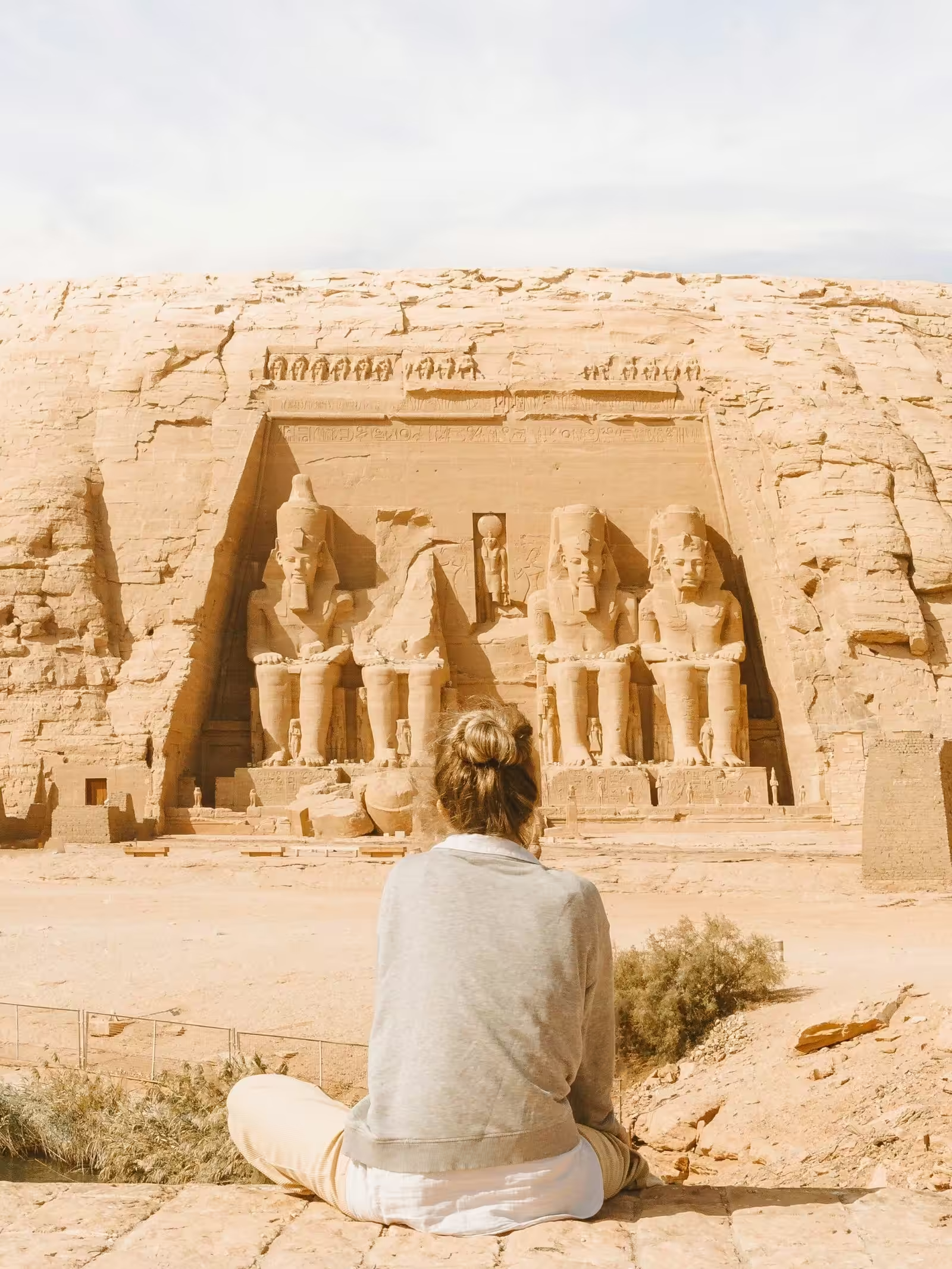
Located 280 kilometers south of Aswan, near the Sudanese border, the twin temples of Abu Simbel were built by Ramesses II around 1264 BC. The Great Temple is carved directly into a sandstone cliff, with four colossal statues of Ramesses II — each 20 meters tall — guarding the entrance. Inside, the temple extends 60 meters into the cliff, its walls covered in detailed reliefs depicting Ramesses II’s military campaigns, particularly the famous Battle of Kadesh against the Hittites.
Like Philae, Abu Simbel was saved from the rising waters of Lake Nasser in a remarkable UNESCO rescue operation — cut into blocks of up to 30 tons, moved 65 meters uphill, and reassembled with such precision that the interior was realigned to preserve the original astronomical phenomenon:
Twice a year — on February 22nd and October 22nd (believed to correspond to Ramesses II’s birthday and coronation day) — the rising sun shines directly through the entrance of the Great Temple and illuminates the four statues in the inner sanctuary, leaving only the statue of Ptah, god of darkness, in shadow. This solar alignment was designed by ancient Egyptian architects 3,300 years ago and was preserved through the 20th-century relocation to an accuracy of one day.
How to Visit Abu Simbel
By convoy from Aswan: The most common option. Daily convoys depart Aswan very early in the morning (typically 3:30–4:00 AM) for the 3.5-hour drive south. The convoy system was established for security reasons and is still the standard approach. The drive itself, through open desert along Lake Nasser, is beautiful in the early morning light.
By flight from Aswan: Egypt Air operates short flights from Aswan to Abu Simbel. The flight takes approximately 45 minutes and is significantly more comfortable, though more expensive. For travelers with limited time or physical limitations, the flight is strongly recommended.
Overnight at Abu Simbel: Staying overnight in Abu Simbel allows you to see the temples at sunrise and sunset — the two most dramatic lighting conditions — and to experience the site in the relative quiet of early morning before day-trip crowds arrive from Aswan.
Best time to visit Abu Simbel: February 22nd and October 22nd draw thousands of visitors for the solar alignment event. If you can plan around these dates, the experience is remarkable. For a quieter visit with similarly good light, early morning in November through January is ideal.
Nile Cruise Between Luxor and Aswan: The Classic Egypt Journey
Sailing the Nile between Luxor and Aswan — a distance of approximately 215 kilometers — has been one of Egypt’s classic travel experiences for over a century. In the 19th century, European aristocrats made the journey by private dahabiya sailboat. Today, the same route is traveled by modern cruise boats ranging from economy to genuinely luxurious.
A typical 3 or 4 night Nile cruise between Luxor and Aswan includes:
- Karnak Temple and Luxor Temple
- Valley of the Kings and Hatshepsut’s Temple
- Edfu Temple (dedicated to Horus — one of the best-preserved in Egypt)
- Kom Ombo Temple (uniquely dedicated to two gods — Sobek and Horus)
- Aswan, including Philae and the High Dam
- Optional excursion to Abu Simbel
The journey combines the most important monuments of Upper Egypt into a single, logistically simple experience. The boat becomes a moving base — you wake up, visit a monument, return to the boat, sail to the next stop, repeat.
For first-time visitors to Upper Egypt who want to cover the maximum monuments in minimum time, a Nile cruise is the most efficient option. For travelers who want depth over breadth, a slower land-based journey with overnight stays in Luxor and Aswan allows more time at each site.
Best Time to Visit Luxor and Aswan
October to April (ideal)
Temperatures are comfortable — 20°C to 32°C during the day, cooler at night. January and February are the coolest months and the peak of international tourist season. December through February is busy but offers the most pleasant conditions.
May and September (shoulder season)
Temperatures rise to 35–40°C. Fewer tourists mean shorter queues and lower prices. Early morning visits to outdoor monuments are manageable.
June to August (not recommended for most)
Temperatures regularly exceed 42°C in Luxor and 45°C in Aswan. Visiting the Valley of the Kings in peak summer requires serious heat preparation. Most international tourists avoid these months.
For photographers specifically: The golden hour light in Luxor in November and December is extraordinary — warm, low, and long-lasting. The combination of sandstone monuments and amber evening light is as beautiful as anywhere on Earth.
How Many Days Do You Need?
Luxor only — minimum 2 days: Day 1: Karnak, Luxor Temple (evening) Day 2: West Bank — Valley of the Kings, Hatshepsut, Colossi of Memnon
Luxor only — ideal 3 days: Adds time for the Valley of the Queens, Medinet Habu temple, deeper exploration of the better tombs, and a sunset felucca on the Nile.
Aswan only — minimum 1.5 days: Philae, High Dam, Nubian village, Nile felucca sail. Abu Simbel as a long day trip.
Aswan only — ideal 2 days: Adds a proper Abu Simbel overnight or more time in the Nubian villages and the old souk.
Luxor + Aswan combined — ideal 5 to 6 days: This gives you genuine depth at both destinations without rushing.
Practical Travel Information
Getting to Luxor
- By flight: EgyptAir and budget carriers operate multiple daily flights from Cairo (1 hour) and less frequent services from other Egyptian cities
- By train: Egypt’s overnight sleeper train from Cairo to Luxor is a classic experience — comfortable, scenic, and significantly cheaper than flying. The journey takes approximately 10 hours
- By Nile cruise: Starting a southbound cruise from Luxor is the most scenic arrival
Getting to Aswan
- By flight: Regular flights from Cairo (1.5 hours) and Luxor (45 minutes)
- By train: Regular and sleeper services from Cairo (12+ hours) and Luxor (3 hours)
- By Nile cruise: The natural conclusion of a northbound or southbound cruise
Getting Around
Within Luxor and Aswan, taxis, tuk-tuks, horse-drawn carriages (calèches), and private vehicles are all available. Hiring a private driver for a full day on the West Bank is the most efficient way to cover multiple sites.
What Most Travel Guides Get Wrong About Luxor and Aswan
Most guides describe Luxor and Aswan as a list of monuments to check off. This misses the point entirely.
The best experience of Upper Egypt is not about how many temples you enter — it is about choosing fewer places and spending longer in each one. The Valley of the Kings rewards the traveler who spends three hours there, not the traveler who rushes through four tombs in forty minutes.
Similarly, Aswan rewards slowness. An afternoon on a felucca, drifting between islands as the light changes on the granite boulders, with a cup of hot tea and no particular agenda, is more valuable than rushing to fill every hour with monuments.
Luxor and Aswan are places where the quality of attention you bring determines the quality of the experience you leave with.
Why Visit Luxor and Aswan With a Local Guide
The monuments of Upper Egypt are layered — every wall tells a story, every column has a history, every figure in a relief is doing something specific within a complex theological narrative. A knowledgeable local guide transforms a walk through ancient stones into a living story.
The difference between visiting Karnak alone and visiting Karnak with someone who can explain the political history encoded in the reliefs, identify the cartouches of specific pharaohs, and point out the places where a later king deliberately defaced his predecessor’s name — that difference is the difference between tourism and genuine understanding.
Final Thoughts
Luxor and Aswan are not simply destinations. They are an education — in human ambition, in artistic achievement, in the peculiar persistence of beauty across thousands of years of time.
Traveling this stretch of the Nile, from the temples of Karnak in the north to the cliffs of Abu Simbel near the Sudanese border, you follow the same route that Herodotus followed in the 5th century BC, that Napoleon’s scholars documented in the 1790s, and that Carter and Carnarvon traveled in 1922 when they discovered Tutankhamun.
You are not visiting ruins. You are walking through the memory of a civilization that shaped the world.
Ready to experience Luxor and Aswan? Tamer Safari organizes private customized tours to Luxor, Aswan, and Abu Simbel — fully tailored around your schedule, pace, and interests. 📧 info@tamersafari.com | 📱 WhatsApp: +201228399260

Recent Posts
Sharm El-Sheikh Egypt: The Ultimate Travel Guide (2026)

Hurghada Egypt: The Ultimate Travel Guide (2026)