White Desert & Black Desert Egypt: The Ultimate Travel Guide (2026)
Introduction: Where Egypt Surprises Even the Most Experienced Travelers
Most people come to Egypt for the pyramids. A few discover something far more extraordinary.
About 370 kilometers southwest of Cairo, hidden beyond rolling desert highways and volcanic black mountains, lies one of the most visually stunning natural landscapes on Earth — Egypt’s White Desert. A place where chalk formations rise from the sand like alien sculptures, where the silence is so complete you can hear your own heartbeat, and where the night sky performs a show that no city dweller has ever truly seen.
The White Desert is not just a destination. It is an experience that resets you.
This guide covers everything you need to know — the Black Desert, Crystal Mountain, Agabat Valley, overnight desert camping, the best time to visit, and how to plan your journey from Cairo or Bahariya Oasis.
What Is the White Desert?
The White Desert — known in Arabic as Al-Sahara Al-Baida — is a protected national park located in the Farafra Depression of Egypt’s Western Desert, within the New Valley Governorate. It was officially declared a national park in 2002 and covers approximately 3,010 square kilometers.
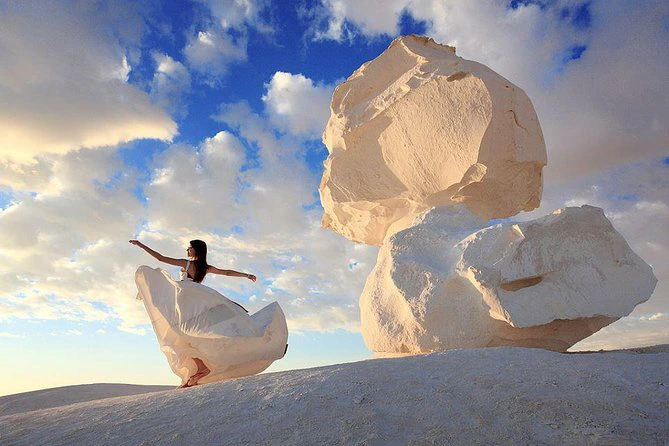
What makes it unforgettable is the extraordinary rock formations. Over millions of years, wind erosion shaped massive deposits of chalk and limestone into forms that look like mushrooms, chickens, rabbits, ice cream cones, and twisted human figures. These formations glow bright white under sunlight and turn a surreal shade of golden-pink at sunset, then appear almost luminescent under a full moon.
The White Desert is not a single landmark — it is an evolving landscape that changes color, mood, and atmosphere depending on the time of day and the season.
The Black Desert: Your First Stop on the Journey
Before reaching the White Desert, most travelers pass through the Black Desert — a dramatically different but equally impressive landscape located just south of Bahariya Oasis.
The Black Desert gets its name from the millions of dark volcanic rocks that blanket the desert floor and coat the tops of cone-shaped hills and mountains. These rocks are remnants of ancient volcanic activity. The ground is literally black, creating a stark, otherworldly contrast against the pale sand and blue sky.
What to see and do in the Black Desert:
- Climb one of the volcanic cones for a panoramic view across the entire landscape
- Watch the desert shift from brown sand to pure black rock as you drive deeper in
- Stop for photos at the most dramatic geological formations
- Look for the fossilized seashells scattered in the sand — proof that this entire region was once the floor of an ancient ocean
The Black Desert is typically the first major stop on any White Desert tour from Bahariya Oasis, making it a perfect contrast experience before the pale chalk world ahead.
Crystal Mountain: Egypt’s Hidden Gemstone
Between the Black Desert and the White Desert sits one of Egypt’s most underrated natural wonders — Crystal Mountain, locally known as Gebel al-Izzaz.
This small rocky ridge is composed almost entirely of calcite crystals that catch the light and sparkle across the surface. When the sun hits it at the right angle, the entire mountain glitters. It is not large — you could walk around it in minutes — but it is genuinely breathtaking up close.
Travelers often underestimate Crystal Mountain because it sounds like a fantasy. When they actually stand in front of it, hands touching crystal-studded rock in the middle of the Egyptian desert, they understand why it made the journey worth it before the White Desert even began.
Practical tip: Visit in the morning when the light is low and directly on the eastern face. The crystals reflect most dramatically in early light.
Agabat Valley: The Secret Within the Journey
Agabat Valley — also written as Aqabat — is a less-visited but absolutely stunning stretch of desert landscape between Bahariya and the White Desert. It is often skipped on shorter tours but included in the best-planned journeys.
The valley is characterized by dramatic formations of rock and sand, with a scale and emptiness that makes you feel genuinely small in the most magnificent way. Driving through Agabat Valley feels like moving through a landscape that no human hand has ever touched.
This is the kind of place that serious desert travelers come back to Egypt to see again.
The White Desert: Core Formations and What to Expect
The White Desert itself is divided into an Old White Desert and a New White Desert. Most tours focus on the New White Desert, where the chalk formations are most dramatic and densely clustered.
The Most Famous Formations
The Mushroom Rock — Perhaps the most photographed formation in the entire desert. A massive chalk boulder balanced on a thin eroded base, standing alone in an open field of white sand.
The Rabbit and the Chicken — Two formations that local guides have named for their animal shapes. Once you see the resemblance, you cannot unsee it.
The Inselbergs — Tall, isolated chalk towers that rise dramatically from the flat desert floor, casting long blue shadows in the evening light.
What is remarkable about the White Desert is that it looks completely different at different hours. At noon, it is blindingly white against a blue sky. At golden hour, every formation turns warm amber and orange. At night, under moonlight, the white chalk literally glows.
Overnight Camping in the White Desert: The Real Reason to Go
A day trip to the White Desert exists, technically. But anyone who has spent a night there will tell you: if you only go for the day, you missed the entire point.
Sunset in the White Desert is one of Egypt’s most extraordinary natural events. The chalk turns amber, then pink, then deep violet as the sun drops. The temperature falls fast. The wind stills. And then the stars begin.
The White Desert night sky is among the clearest in the world. At 28 degrees north latitude, with zero light pollution for hundreds of kilometers in every direction, the Milky Way appears in full, dense, overwhelming clarity. Travelers who have seen night skies across five continents consistently describe the White Desert as one of the best they have ever witnessed.
What overnight camping includes:
- Setup of a traditional Bedouin camp in a scenic location among the formations
- Fireside dinner prepared fresh by the guide — usually rice, grilled chicken or kofta, salad, and bread
- Bedouin tea brewed over open flame
- Sleeping under the open stars or in a tent depending on the season
- Waking up to complete silence before sunrise
The experience of waking up inside the White Desert at first light — the formations glowing faintly pink before the sun fully rises, steam rising from the tea your guide has already prepared — is something that stays with you for years.
How to Get to the White Desert
From Cairo
The most common starting point is Cairo. The journey takes approximately 4 to 5 hours by private car or tourist vehicle, traveling southwest on the Western Desert Road (Desert Road) toward Bahariya Oasis.
By private tour: The most comfortable and recommended option. Your guide picks you up from Cairo, drives to Bahariya Oasis, and continues into the desert.
By public bus: Buses from Cairo’s Turgoman Station run to Bahariya Oasis approximately twice daily. From Bahariya, you need a guide and 4×4 vehicle to continue into the desert.
By private car: Possible but not recommended without a local guide. Desert navigation in the White Desert requires experience — formations look different from different angles and it is genuinely easy to become disoriented.
From Bahariya Oasis (Bawiti)
If you are already in Bahariya Oasis, the White Desert is approximately 120 kilometers south. A 4×4 vehicle is required beyond the main road. All reputable tours depart from Bawiti.
How Long Does a White Desert Tour Take?
1-day trip (not recommended): Possible from Bahariya but you miss the night sky entirely. Suitable only for travelers with severe time constraints.
2-day / 1-night (most popular): Depart from Cairo or Bahariya in the morning, visit the Black Desert and Crystal Mountain, arrive at the White Desert by late afternoon, camp overnight, return the next morning. This is the ideal minimum.
3-day / 2-night: Adds Agabat Valley, more exploration of the formations, a second night camping, and time to properly absorb the landscape without rushing. Highly recommended for photographers and travelers who want to experience the full range of light conditions.
Extended journeys (4+ days): Can include Farafra Oasis, the deep desert, and connections to other oases further along the Great Desert Circuit.
Best Time to Visit the White Desert
October to April (recommended)
These months offer comfortable daytime temperatures (15°C to 25°C) and cold but manageable nights (0°C to 10°C). December and January require a warm sleeping bag but offer the clearest skies and best stargazing conditions.
May to September (not recommended for most travelers)
Daytime temperatures exceed 40°C and can reach 48°C. Desert camping becomes genuinely dangerous in peak summer. Most experienced guides do not run overnight camping trips during these months.
For photographers: January and February offer the most dramatic contrast between the white formations and deep blue winter sky. Golden hour in winter lasts longer and the light is particularly warm.
What to Pack for a White Desert Trip
Clothing:
- Light, breathable layers for daytime (the desert reflects heat)
- Warm jacket and fleece for evenings — temperatures drop rapidly after sunset regardless of the season
- Closed-toe shoes or light hiking boots — the sand can be rough
- Scarf or buff to protect against wind and sand
Gear:
- Camera with a wide-angle lens — the landscapes demand wide shots
- Extra camera batteries — cold nights drain batteries fast
- Power bank for phone charging
- Headlamp or torch
Health and safety:
- Sunscreen (SPF 50+) — the white chalk reflects UV radiation intensely
- Sunglasses — polarized preferred
- Lip balm — the dry air dehydrates skin and lips quickly
- Sufficient water — your guide will provide this but bring your own as backup
- Any personal medications
What Does a White Desert Tour Cost?
Prices vary significantly depending on the departure point, group size, duration, and quality of the operator. As a general guide:
From Cairo, 2-day/1-night private tour: USD 150–280 per person depending on group size
From Bahariya Oasis, 2-day/1-night: USD 80–150 per person
Inclusions to look for:
- Transportation (4×4 vehicle)
- Guide fees and park entrance
- All meals and water during the desert portion
- Camping equipment
- Return transfer
Always confirm what is and is not included before booking. The cheapest options sometimes exclude meals, park fees, or use older vehicles.
Is the White Desert Safe?
Yes. The White Desert is one of Egypt’s safest and most well-established tourist destinations. The area is within a national park, regularly patrolled, and has been welcoming international tourists for decades.
Safety considerations:
- Always go with a registered, experienced local guide — desert navigation requires genuine expertise
- Never attempt to self-drive into the deep desert without local knowledge
- Inform someone of your travel plans and expected return
- In summer, avoid camping — extreme heat is a genuine safety risk
- Carry more water than you think you need
The Egyptian government maintains tourism safety in this area, and reputable guides take their guests’ security seriously as a professional and personal priority.
White Desert vs Black Desert: Which Is Better?
This is a common question from first-time visitors and the answer is simple: both, together, in the right order.
The Black Desert and White Desert are entirely different experiences that complement each other perfectly. Starting with the dark volcanic landscape of the Black Desert and ending in the pale chalk formations of the White Desert gives the journey a narrative — from geological drama to ethereal beauty.
Choosing one over the other is like seeing half a film. The journey is the point.
Why the White Desert Matters for Egypt’s Tourism Identity
The White Desert is one of Egypt’s most significant natural assets and yet it remains largely unknown outside of serious travel communities. While millions of visitors come to Egypt each year and see nothing beyond Cairo, Luxor, and Hurghada, the White Desert represents a completely different dimension of what Egypt offers.
It is a landscape that has no equal anywhere in North Africa. The combination of accessible location (relative to Cairo), extraordinary natural beauty, cultural richness through Bedouin hospitality, and near-perfect conditions for night sky observation makes it genuinely world-class.
Travelers who visit consistently report it as the highlight of their entire Egypt experience — above the pyramids, above Luxor, above everything else.
Final Thoughts
The White Desert is not a place you visit once and check off a list. It is a place that changes you slightly, that makes you quieter and more patient, that gives you a sense of scale that modern life rarely provides.
If you are planning a trip to Egypt and have even two extra days beyond the standard itinerary, spend them here. Leave Cairo before sunrise, drive west toward the desert, and let the landscape do the rest.
You will not regret it.
Ready to experience the White Desert? Contact Tamer Safari — a local Bahariya-based guide with over 15 years of desert experience and more than 194 five-star Tripadvisor reviews. 📧 info@tamersafari.com | 📱 WhatsApp: +201228399260

Recent Posts
Sharm El-Sheikh Egypt: The Ultimate Travel Guide (2026)

Hurghada Egypt: The Ultimate Travel Guide (2026)